Playbook
Blue Ocean vs Red Ocean Strategy: When to Use Each (2026)
Blue Ocean vs Red Ocean Strategy: when to compete in existing markets vs create new demand. ERRC framework, real company examples, and how to choose.

TL;DR. Blue Ocean Strategy is the simultaneous pursuit of differentiation and low cost to open uncontested market space and make competition irrelevant. Developed by W. Chan Kim and Renée Mauborgne at INSEAD and published in 2005, it contrasts blue oceans (uncontested space) with red oceans (existing competitive markets) and offers the Four Actions Framework: Eliminate, Reduce, Raise, Create.

Photo by Evgeniy D. on Unsplash
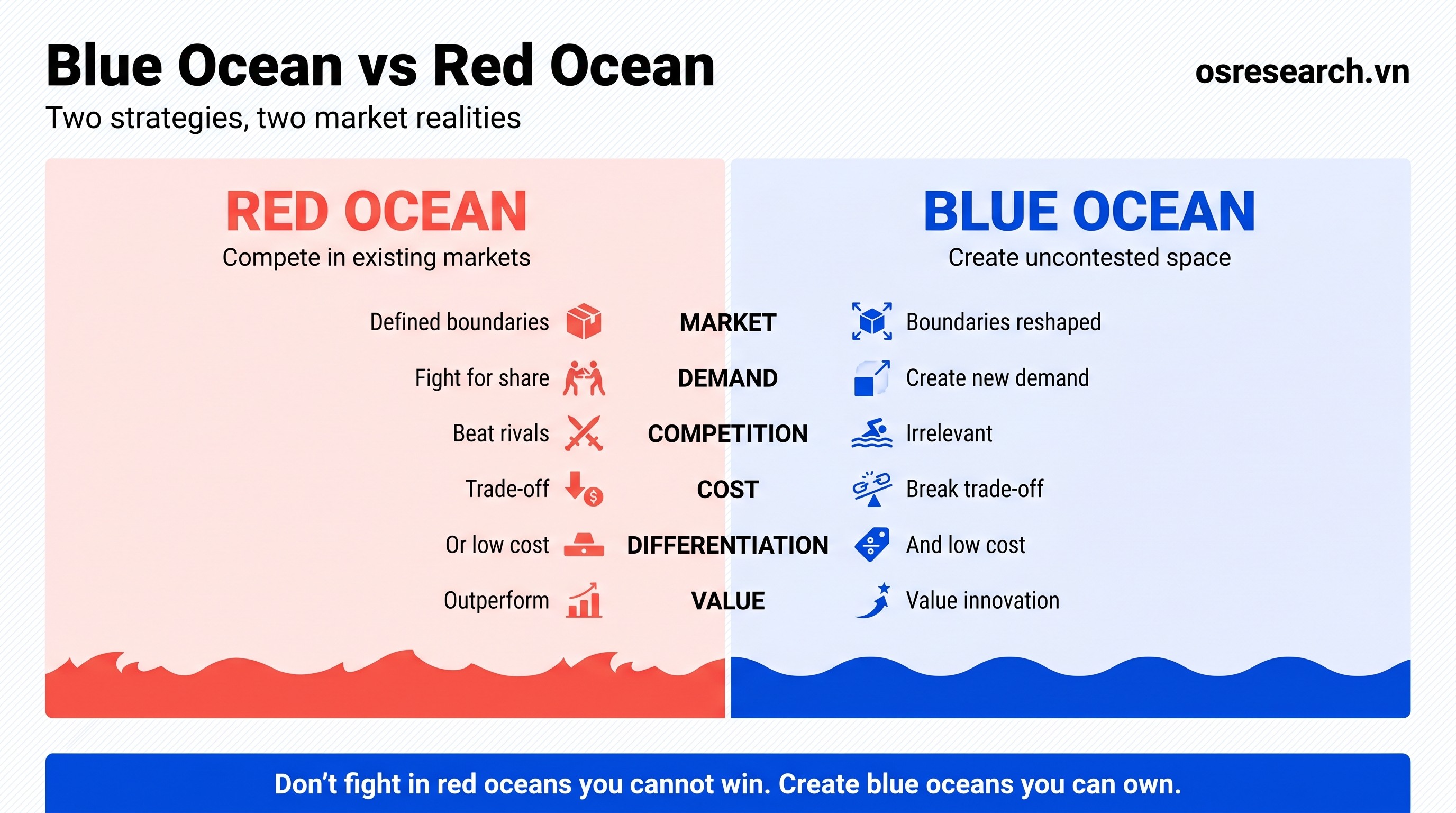
Our diagram of the Kim and Mauborgne framework. Don't fight in red oceans you cannot win.
The core idea
Most strategy assumes the market is fixed and the goal is to outcompete rivals for share. Kim and Mauborgne's insight: market boundaries are constructed by industry players, not given. By redefining what the product is and who it serves, a company can create uncontested space where competition is irrelevant.
The 2005 book Blue Ocean Strategy is based on a 15-year study of 150+ strategic moves across 30 industries spanning 100 years. The conclusion: companies that created blue oceans achieved higher growth and profit than those competing in red oceans.
Red ocean vs blue ocean
Dimension | Red Ocean | Blue Ocean |
|---|---|---|
Market space | Existing, defined | New, uncontested |
Competition | Outperform rivals for share | Make competition irrelevant |
Demand | Exploit existing | Create new |
Value-cost trade-off | Choose differentiation OR low cost | Pursue both simultaneously |
Strategic action | Compete on industry conventions | Break industry conventions |
In a red ocean, the rules of competition are known. Companies fight for a bigger share of shrinking demand by outperforming rivals on existing factors. The water turns red with competition.
In a blue ocean, there is no competition yet because the rules don't exist. The company creates new demand by serving new customers or serving existing customers in a fundamentally different way.
The Four Actions Framework
The signature tool of Blue Ocean Strategy. To create new market space, ask these four questions:
Eliminate, which factors that the industry takes for granted should be eliminated?
Reduce, which factors should be reduced well below the industry standard?
Raise, which factors should be raised well above the industry standard?
Create, which factors should be created that the industry has never offered?
These four actions together produce a new value curve. The point isn't to differentiate slightly on every factor, it's to differ radically by ELIMINATING and CREATING.
Classic examples
Cirque du Soleil (used by Kim+Mauborgne as opening case):
Eliminated: animal acts, multiple show tents, star performers
Reduced: aisle concessions, traditional ticket pricing
Raised: artistic music, refined venue
Created: theme, sophisticated audience targeting, story
Result: Created the "theatrical circus" category that didn't exist, with both differentiation AND lower cost than traditional circus or theater
Nintendo Wii (vs Sony PS3, Xbox 360, 2006):
Eliminated: HD graphics race, gamer-only positioning
Reduced: processing power, technical specs
Raised: physical motion gameplay, family-friendliness
Created: motion-sensing controller as primary interface, casual gaming category
Result: Outsold both PS3 and Xbox 360 in early generation despite lower-spec hardware
Yellow Tail wine (Casella Wines, Australia):
Eliminated: enological complexity, oak aging, marketing campaigns
Reduced: wine range complexity
Raised: ease of selection, fun branding
Created: easy-drinking wine for beer/cocktail drinkers
Result: Became #1 imported wine in US within 2 years of US launch
Common Blue Ocean mistakes
Three patterns where Blue Ocean thinking misleads:
Assuming "new market" = "blue ocean": A novel product category doesn't automatically mean Blue Ocean. Many "new" categories turn out to be unprofitable wastes of time. Real Blue Ocean requires both new demand AND a sustainable value-cost position.
Skipping the customer side: The Four Actions Framework can be done in isolation, producing internally satisfying redesigns that nobody wants to buy. Pair it with customer interviews and validation experiments.
Differentiating on every factor: Yellow Tail beats traditional wine by being LESS sophisticated. Cirque du Soleil eliminated animal acts. The framework's power is asymmetric, most of its impact comes from ELIMINATE and CREATE, not from incremental Raise.

Photo by Harli Marten on Unsplash
When Red Ocean strategy is actually correct
Blue Ocean Strategy is right less often than the popular conversation suggests. Red Ocean strategy is correct when:
The category has structural defensibility (network effects, switching costs, regulatory moats) that benefit incumbents
The market is large enough that incremental share matters more than category creation
Your team's edge is operational excellence in a known category, not category creation
Capital required to create a new category exceeds what's available for the bet
A defensible decision rule: pursue Blue Ocean only when validated customer demand is strong enough to support category creation. Otherwise, find a narrow differentiation in a Red Ocean and execute.
A Vietnamese Blue Ocean example: Topica English
Before Topica entered Vietnam's English-learning market in the late 2000s, the category was Red Ocean: classroom-based programs (ACET, Apollo, Britain English Centre, ILA) competing on teacher quality, location, and price.
Topica's Four Actions:
Eliminated: physical classrooms, fixed schedules
Reduced: teacher cost per student (live + AI mix), enrollment process complexity
Raised: convenience (24/7 access), homework AI feedback speed
Created: online live tutoring for English speaking practice with native speakers worldwide
Result: by 2015, Topica was the largest online English learning company in Southeast Asia. The category they created (online live tutoring) didn't exist in Vietnam before.
How we use Blue Ocean Strategy
Run a Strategy Canvas (the visual version of Four Actions Framework) before committing to a market. The canvas:
X-axis: competing factors in the category (price, features, distribution channels, etc.)
Y-axis: relative position (low to high)
Two value curves: existing industry leaders + our planned offering
The OS Research offering's value curve should look RADICALLY different from competitors, not slightly higher on every factor. If the curves look similar, we're in a Red Ocean and need to reconsider.
Common mistakes
Confusing 'no direct competitors' with 'blue ocean' (often it just means no market)
Skipping the Strategy Canvas (the diagnostic that reveals true ocean color)
Eliminating wrong factors (cutting the actual value-add)
Treating Cirque du Soleil as a template instead of an analogy
Declaring blue ocean before running ERRC analysis with customer evidence
Frequently asked questions
Q: What is Blue Ocean Strategy?
A: The simultaneous pursuit of differentiation and low cost to open uncontested market space and make competition irrelevant. Developed by W. Chan Kim and Renée Mauborgne (INSEAD, 2005).
Q: Who created Blue Ocean Strategy?
A: W. Chan Kim and Renée Mauborgne, professors at INSEAD business school. Published the book Blue Ocean Strategy in 2005.
Q: What is the difference between red ocean and blue ocean?
A: Red oceans are existing competitive markets where companies fight for share. Blue oceans are uncontested markets where new demand is created. Red ocean competes; blue ocean creates.
Q: What is the Four Actions Framework?
A: The Blue Ocean Strategy tool: Eliminate (factors industry takes for granted), Reduce (well below industry standard), Raise (well above industry standard), Create (never offered before). The combination produces a new value curve.
Q: Can you give examples of Blue Ocean Strategy?
A: Cirque du Soleil (theatrical circus), Nintendo Wii (motion gaming), Yellow Tail wine (easy-drinking wine), Topica English (online live tutoring in Vietnam), Salesforce (CRM as subscription).
Q: Is Blue Ocean Strategy always better than competing in Red Oceans?
A: No. Red Ocean strategy is correct when categories have structural defensibility, when market is large enough that incremental share matters, when your team's edge is operational excellence, and when capital available is insufficient for category creation.
Q: What is the Strategy Canvas?
A: The visual diagnostic tool from Blue Ocean Strategy. X-axis lists competing factors. Y-axis shows relative position. Two value curves: industry leaders + your planned offering. Real Blue Ocean offerings have radically different value curves.