Methodology
How to Raise a Seed Round: 2026 Founder's Playbook
Average seed in 2026 is $4.4M and the bar has risen. OS Research playbook: whether to raise, what to prove first, SAFE vs priced decision model.

TL;DR. Most seed-fundraising guides assume you should raise and then teach you how. The harder, more important decision sits earlier: should you raise at all, what should you have proven first, and what does taking institutional capital commit you to. In 2026, the bar has risen. Average seed rounds are around $4.4 million but investors expect product-market fit signals, not just product-launch signals. SAFE remains the dominant instrument at 92 percent of pre-seed rounds. This piece walks through the decision tree before the tactics, the validation gates that justify raising, and the tradeoffs most guides skip.

Photo by CHUTTERSNAP on Unsplash
What raising a seed round actually means in 2026
A seed round is the first institutional capital round for a startup. It typically follows a pre-seed round funded by founders, friends, family, and angels, and precedes a Series A. The amounts have shifted over time. As of early 2026, the average seed round is approximately $4.4 million, with significant range above and below depending on geography, sector, and founder traction.
What the round actually buys has also shifted. The 2018 to 2021 era was characterized by "raise more than you need now because capital is cheap." The 2022 to 2024 reset reversed that thinking. The 2026 norm is "raise enough to reach a clear milestone in 12 to 18 months, no more." Investors fund efficient growth, not optionality.
The 2026 expectations from seed investors are also different. The seed round used to be "we believe in the team and the idea." It is now "we believe in the team, the idea, and the early evidence." The early evidence typically includes:
A working product (or demonstrable prototype)
Initial users or customers (not at scale, but real)
Early signals of product-market fit (retention curves, repeat usage, willingness to pay)
A specific go-to-market motion that you can articulate
A clear milestone the round will reach (typically Series A readiness)
Founders who skip the early evidence and try to raise on idea-and-team alone in 2026 face a steeper path than the 2021 environment offered. The seed bar has effectively moved closer to where Series A bar used to be.
The decision underneath: should you raise at all?
The first honest question is not how to raise, but whether to raise. Most fundraising guides skip this question because they exist to help founders who have decided. The decision itself deserves the most attention.
Three structural questions determine whether raising is the right move.
Can you reach the next material milestone without external capital?
For some businesses, the answer is yes. Bootstrapped to profitability is possible for many B2B SaaS, services, and consumer software businesses, particularly if the founder has personal runway and can compound revenue gradually. The bootstrapped path is slower but produces a different cap table, optionality, and founder control profile.
For other businesses, the answer is no. Some businesses require capital before revenue (deep-tech, hardware, regulated industries, two-sided marketplaces with chicken-and-egg dynamics). Some businesses face competitive races where moving fast matters and capital enables the speed. For these, the decision is not whether to raise but when.
The honest question is which category your business sits in. Founders sometimes assume they need capital when bootstrapping would work; others assume they can bootstrap when capital is genuinely required. Both errors have a cost.
Are you ready for the operating cadence that institutional capital imposes?
Taking institutional capital changes the operating cadence. Monthly board updates. Quarterly investor reviews. Pressure toward growth milestones on the investor's timeline, not just the founder's. Dilution at this round and at future rounds. Liquidation preferences that affect your outcome at exit.
Founders who do not understand or do not want this cadence often regret raising. The capital is real; the operating commitments that come with it are also real. Saying yes to institutional capital is saying yes to a five-to-ten-year arc with specific external expectations.
Are you raising because you need to, or because everyone else is?
The most common bad reason to raise is social pressure. Other founders in your cohort are raising. Articles celebrate fundraising. The startup ecosystem treats fundraising as the achievement, even though fundraising is just receiving money in exchange for equity, which is the opposite of an achievement on its own. The actual achievement is building a business that justifies the capital.
If you can articulate a specific milestone that requires capital and a credible path to that milestone, raise. If the answer is "we want to grow faster" without specifics, the diagnostic is incomplete. Run the validate business idea framework first; raise after you can name what the capital buys.
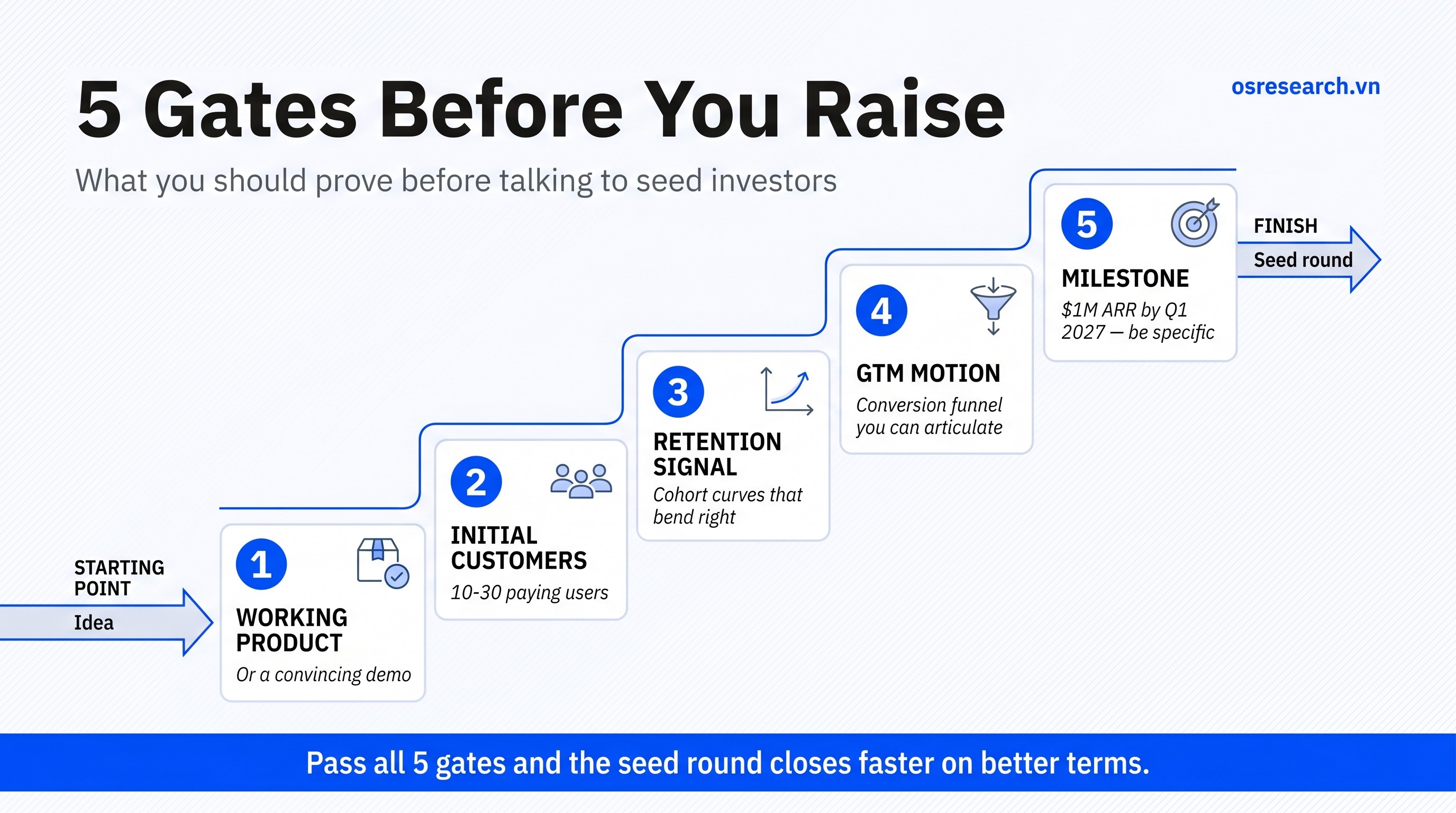
The 2026 seed bar requires all 5 gates passed before investor conversations.
The validation gates that justify a seed raise
Assuming the answer to "should I raise" is yes, the next question is "have I proven enough yet to raise effectively." The 2026 seed bar typically requires five gates passed:
Gate 1: A working product or convincing prototype. The product exists in a form investors can interact with or see demonstrated. The era of pre-product seed rounds for first-time founders is largely over (with exceptions for repeat founders, deep-tech, or extraordinary teams).
Gate 2: Initial users or customers. Not at scale, but real. For B2B SaaS: 10 to 30 paying customers or design partners. For consumer software: meaningful weekly or monthly active users with retention signal. For marketplaces: liquidity in at least one geography or segment.
Gate 3: Early product-market fit signals. Cohort retention curves that bend the right way (4-week retention above 25-35 percent for typical SaaS; significantly higher for community products). Net promoter score signals. Repeat usage. Willingness to pay confirmed.
Gate 4: A specific go-to-market motion. Not "we will figure it out" but "we are running PLG with content marketing, here is the conversion funnel." See our go to market strategy piece for the motion diagnostic.
Gate 5: A credible milestone the round buys. Concrete: "$2M to reach $1M ARR by Q1 2027" or "$3M to reach 100k MAU and launch in two additional markets." Vague milestones produce vague investor interest.
Founders who try to raise without these gates often struggle to close. Investor objections cluster around the missing gates. Founders who pass all five gates typically raise faster, on better terms, with stronger investor partners. The gates exist whether or not the founder names them; investors apply them implicitly.
The 2026 environment specifics that matter
Three structural shifts affect how seed rounds work in 2026 compared to 2021.
SAFE remains dominant. Approximately 92 percent of pre-seed rounds use SAFEs (Simple Agreement for Future Equity). SAFEs convert to equity at the next priced round, typically Series A. The valuation cap and discount terms in the SAFE determine the conversion math. SAFEs are simpler, faster, and cheaper than priced rounds, which is why they have become the default. The seed round itself is more often a priced round (formal equity issuance with a valuation), particularly above $2M, but SAFEs are also used for seed rounds in many cases.
The "efficient growth" bar. Investors look for capital efficiency, not just top-line growth. CAC payback periods of 12 to 18 months. Gross margins above 60 percent for software businesses. Cohort retention that holds. Net dollar retention approaching 100 percent. Founders presenting growth without margin discipline get fewer commitments in 2026 than they did in 2021.
The AI strategy requirement. Almost regardless of sector, investors expect an AI strategy. Not "we will use AI" but how AI creates defensibility in your specific business. The expectation has solidified through 2024 to 2026 and is now nearly universal among institutional seed investors.
Smaller rounds and tighter terms. The 2021 trend of jumbo seed rounds ($8M+) has retreated to more disciplined sizing. $2M to $4M is now the common range. Liquidation preferences have shifted from founder-friendly 1x non-participating to occasionally 1.5x or 2x in tougher rounds. Term sheets warrant careful reading.
The 12 to 18 month milestone framing. Raising 24 months of runway is now unusual; 12 to 18 months is the norm. Investors expect founders to be back in the market for Series A within that window, which puts pressure on the seed milestone to be sharp and achievable.
The SAFE vs priced round decision
For founders raising a seed round, the choice between SAFE and priced round affects dilution, control, and signaling.
SAFE advantages. Faster close (often two to four weeks instead of two to three months for a priced round). Cheaper legal cost ($5,000 to $15,000 instead of $25,000 to $50,000). No immediate valuation set, which reduces founder-investor friction on the price discussion. More flexibility on adding investors during the round.
SAFE disadvantages. Aggregate dilution at conversion can be higher than expected if multiple SAFEs accumulate. No board seat or formal governance from SAFE investors. Less signaling value than a priced round.
Priced round advantages. Establishes a clear valuation, useful for option grants and team morale. Formal board structure with seed-stage governance. Stronger signaling to subsequent investors that the round has institutional discipline. Negotiated terms (protective provisions, liquidation preferences) provide clearer rules.
Priced round disadvantages. Slower and more expensive to close. Valuation discussion can become friction if founder and investor expectations differ materially. More legal overhead post-close (board meetings, formal record-keeping).
The decision typically follows from the size and composition of the round. Small rounds with multiple angel-style investors usually use SAFEs. Larger rounds with one or two lead institutional investors usually use priced rounds. Mid-size rounds are case-by-case.
The dilution math is also worth modeling explicitly. Stacking multiple SAFEs with different valuation caps can produce surprising dilution at conversion. Use a cap table tool (Carta, Pulley, AngelList) to model the conversion before signing the third or fourth SAFE.

Photo by Radission US on Unsplash
A worked example: the seed raise decision tree
A founder had a B2B SaaS product targeting marketing analytics for mid-market e-commerce. Two co-founders. Pre-product when the conversation started.
The initial question: should we raise a seed round now?
The diagnostic:
Pre-product. Not ready for seed. The 2026 bar requires a working product. The founders worked on it for three months and shipped an MVP.
10 customers paying. Initial signal but below the 30-customer threshold most seed investors want for B2B SaaS. The founders extended pre-seed runway by six months and grew to 35 customers, with 4-week retention of 42 percent (above SaaS benchmark).
GTM motion was MLG with content marketing into the e-commerce community. Conversion funnel was clear: content traffic to free trial to paid, with 18 percent trial-to-paid conversion. Specific enough.
Milestone for the seed: $2.5M to reach 200 customers and $50k MRR by month 12, positioning for Series A. Specific. Defensible.
The founders then raised a $2.5M seed round via SAFE notes from three angel investors and one institutional lead, with a valuation cap of $15M. The round closed in seven weeks. Two terms negotiated: standard 1x non-participating liquidation preference; pro-rata rights for the lead investor.
What made the round close quickly: passing all five gates before starting the conversation, having specific milestone math, naming the AI strategy clearly (proprietary retention modeling using anonymized e-commerce data the company had collected during pre-seed), and being clear on the SAFE structure upfront.
What would have made the round fail: trying to raise pre-product or pre-traction; vague milestones; no AI strategy beyond "we use machine learning"; uncertain GTM motion.
The decision tree before the tactics produced the conditions for the round to close. The tactics (deck, warm intros, due diligence) ran smoothly because the underlying business was ready.
Common mistakes
Raising before passing the validation gates. The 2026 seed bar requires working product, initial customers, retention signal, GTM motion, and milestone clarity. Founders who try to raise before passing these gates face long, painful processes that often fail. Pass the gates first; raise after.
Treating the SAFE as free money. SAFEs feel light because they delay valuation conversations. The dilution at conversion is real. Stacking multiple SAFEs without modeling the conversion math often produces ownership outcomes founders did not expect. Model conversions before signing.
Vague milestone framing. "We will use this capital to grow" is not a milestone. "$2M to reach $1M ARR by Q1 2027 with $X allocated to engineering hires and $Y to growth" is. Specificity matters in two ways: it makes investors confident in the founder's planning, and it gives the team a target to organize around.
Raising too much. The 2018 to 2021 instinct was to raise as much as possible. The 2026 reality is that raising more than 18 months of runway typically signals lack of capital discipline. Raise what reaches the next material milestone, no more.
Negotiating before warm intros. Founders who push for terms before establishing investor relationship and trust typically get worse terms. Build investor relationships before the formal process. Warm intros come from prior relationship; cold pitches close at much lower rates.
Skipping the "should I raise" question. Founders who never asked themselves whether bootstrapping was an option often end up wishing they had. Some businesses do not need venture capital. Raising commits to a five-to-ten-year venture-scale outcome. If the business does not need that, raising is the wrong move.
Frequently asked questions
Q: How much should I raise in a seed round?
A: Raise enough to reach a clear next milestone in 12 to 18 months, no more. In 2026, the average seed round is approximately $4.4 million but the right number for your business depends on your milestone (Series A readiness, profitability, specific market expansion) and your burn rate. Raising too much signals lack of discipline; raising too little risks running out of capital before the milestone.
Q: When is the right time to raise a seed round?
A: After you have passed the five gates: working product, initial customers, early product-market fit signals, specific go-to-market motion, and credible milestone for the round. Raising before the gates have been passed produces a long, often-failing process. Raising after the gates have been passed typically produces faster closes on better terms.
Q: How long does it take to raise a seed round?
A: The full process typically takes three to six months from first investor conversation to wire transfer. Faster closes happen when the gates are clearly passed and warm intros are established. Slower closes happen when the gates are weak or the founder is meeting investors cold. Plan for the longer end; be pleasantly surprised by the faster end.
Q: What do investors expect at the seed stage?
A: A working product, initial users or customers, early product-market fit signals, a clear go-to-market motion, AI strategy framed as defensibility, and a specific milestone the round will reach. The bar has risen compared to 2021. Investors look for evidence, not just narrative.
Q: Should I use a SAFE or priced round at seed?
A: For smaller rounds with multiple angel-style investors, SAFE is typically faster and cheaper. For larger rounds with one or two lead institutional investors, a priced round is typically clearer and more structured. Mid-size rounds are case-by-case. Model the dilution math either way before signing.
Q: How is a seed round different from a pre-seed round?
A: Pre-seed is the first capital, usually from founders, friends, family, and angels. Pre-seed is often pre-product or very early. Seed is the first institutional round, typically after a working product and some initial traction. Series A follows seed once product-market fit is demonstrated and the company is ready to scale.
Q: Do I need a pitch deck to raise a seed round?
A: Yes. The pitch deck is the artifact through which investors evaluate the business. Our pitch deck template piece walks through the slides that fit the 2026 bar. The deck is the artifact; the underlying business is what gets the yes.
Q: How much equity should I give up at seed?
A: Typical seed dilution is 15 to 25 percent for the round. Below 15 percent suggests the round is small relative to valuation; above 25 percent suggests the valuation is too low or the round too large. Model the dilution across multiple rounds: a 20 percent seed plus 15 to 20 percent Series A plus options pool can take founder ownership from 100 percent to around 50 percent by the time of Series B.
Q: What is a SAFE, and how does it work?
A: A Simple Agreement for Future Equity is an investment instrument where the investor provides capital that converts to equity at the next priced round. The SAFE has a valuation cap (the maximum valuation at which it converts) and often a discount (a reduction off the priced round valuation). SAFEs are faster and cheaper than priced rounds but stack: multiple SAFEs at different caps can produce complex dilution at conversion.
Q: How does fundraising in Vietnam compare to fundraising in the US?
A: Vietnamese seed rounds are typically smaller (often $500k to $2M) than US averages, deal terms are similar (SAFE dominant, 1x liquidation), and the investor mix is more regional than purely Vietnamese. The companion read on venture capital vietnam covers the Vietnamese investor landscape specifically. Founders in Vietnam often pursue a hybrid path: Vietnamese angels for initial capital, regional and US institutional for Series A.
Q: What is the difference between an investor pipeline and an investor list?
A: An investor list is a list of names. An investor pipeline is a structured tracking system with investor stage, last-contact date, decision timeline, and next action. Founders who treat fundraising as pipeline management close faster and avoid the situation of investors going silent. Treat the raise like a B2B sales process.
Q: Can I raise a seed round without warm intros?
A: Possible but much harder. The data shows warm intros close at materially higher rates than cold outreach. Building relationships with investors before you need to raise, sending occasional updates on your progress, and asking for advice rather than capital all build the trust that converts to warm intros when you formally raise.