Playbook
Asian Unicorns: The 2026 Reality Behind the Numbers
Asia has 475 unicorns, 64 in Southeast Asia — but the 2025-26 reset changed what qualifies. Countries pulling ahead, losing share, and Vietnam's place.

TL;DR. Asia has 475 unicorns. Southeast Asia has 64. The lists circulate widely, but few articles distinguish the operating unicorns from the down-rounded zombies, or map which countries are gaining and losing share through the 2025-26 reset. The easy-capital cycle ended in 2022. The 2026 reality is selective investors, cautious founders, and a regional split where Indonesia and India hold the largest unicorn counts while Vietnam and Singapore produce sharper concentrations. This piece walks through that reality and names what the next Asian unicorn actually looks like.

Photo by Juliana Araujo the artist on Unsplash
What "Asian unicorn" actually means in 2026
The term unicorn entered common usage when Aileen Lee coined it in 2013 to describe private companies valued at over one billion dollars, which were rare enough at the time to warrant a mythical name. The label has held even as the number of unicorns globally has grown to thousands. In Asia, the count reached 475 as of early 2026.
Three regional clusters dominate. India accounts for roughly 110 unicorns. China continues to lead in absolute count despite a slowdown in new minting. Southeast Asia has 64. Smaller clusters exist in Korea, Japan, and the Middle East. Within Southeast Asia, the distribution is uneven: Singapore and Indonesia hold the largest counts; Vietnam has produced six (four of them fintech); Thailand, Philippines, and Malaysia trail.
The headline numbers obscure what changed in the last two years. The easy-capital era of 2018 to 2021 produced a wave of unicorn minting based on top-line growth at significant cash burn. The 2022 to 2024 correction revalued many of those companies down, in some cases below the unicorn threshold. The 2026 reality is that a meaningful fraction of "unicorns on the list" are operationally weaker than their valuation suggests, and a smaller subset are genuinely scaling on durable economics.
The 2025-26 reset that most lists ignore
What changed under the surface matters more than the headline count. Three structural shifts shape what "Asian unicorn" now means.
The funding cycle ended. The 2018 to 2021 period was characterized by abundant late-stage capital from regional and global funds. Soft Bank, Tencent, and dedicated Southeast Asia funds deployed billions at growth-at-all-costs valuations. The 2022 correction removed that capital. Series C and D rounds in 2024 to 2025 are smaller, slower, and contingent on demonstrated unit economics. The unicorns of 2018 to 2021 were minted in a market that no longer exists.
The investor focus changed. Top-line user growth was the binding metric in the prior cycle. Net dollar retention, contribution margins, and CAC payback are the binding metrics in 2026. Companies that scaled to billion-dollar valuations on user growth without margin durability are now in difficult down-round territory. The list of unicorns has not been refreshed to reflect the operational reality.
The path to liquidity narrowed. Public market IPOs for technology companies slowed across Asia from 2022. Secondary markets exist but at discounts. The exit path for the 2018-vintage unicorns is more constrained than the post-money valuations implied. Investors holding those positions are either marking down or sitting on illiquid stakes.
The reset has produced three loose categories within the public unicorn list: operating unicorns that have transitioned to efficient growth and remain financially durable; transitioning unicorns that are restructuring to align with the new bar; and zombie unicorns that hold the valuation on paper but have minimal commercial momentum. The categories are not always visible from outside but matter enormously for understanding what the actual Asian unicorn landscape looks like.
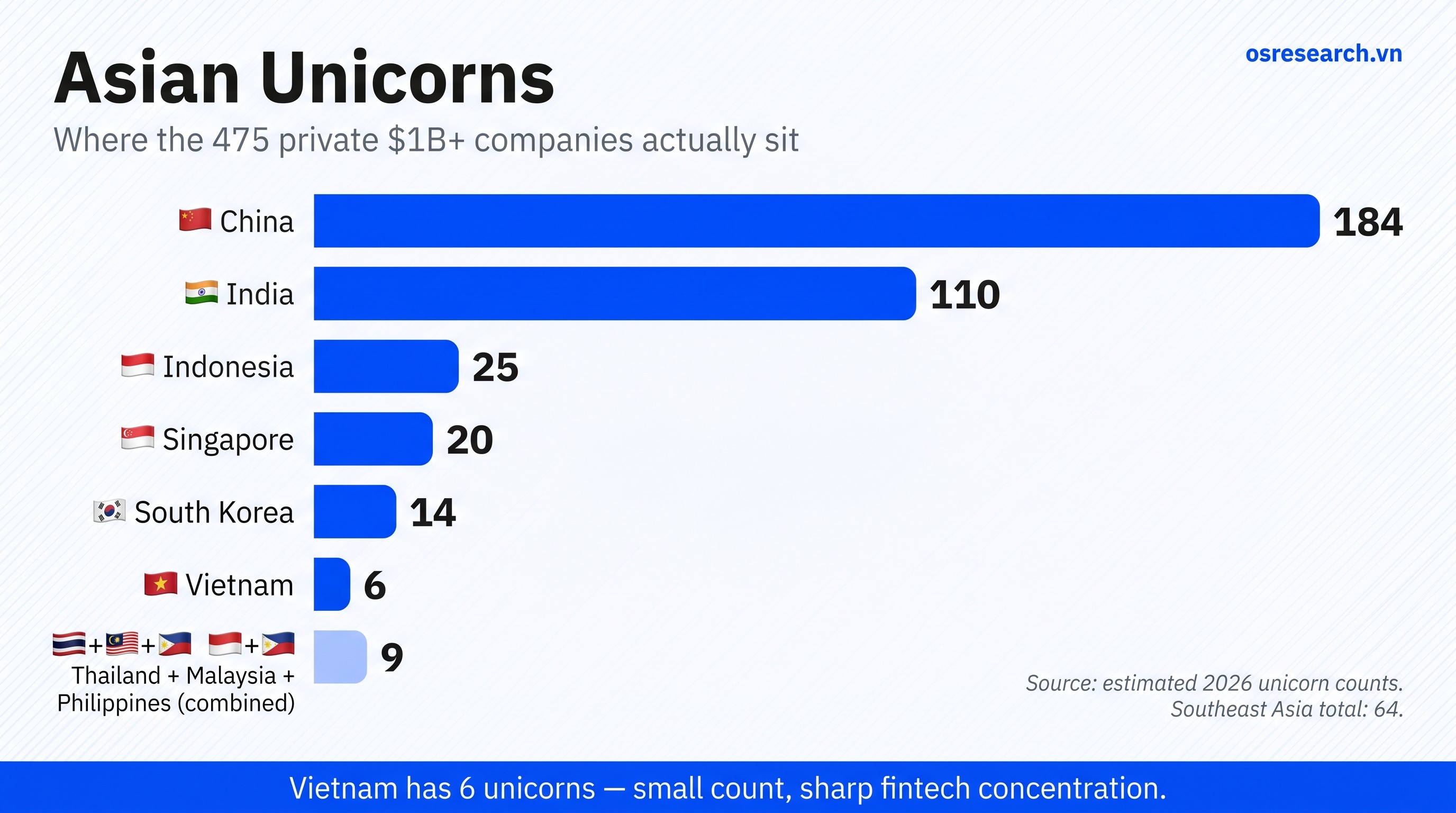
Asia has 475 unicorns; Southeast Asia accounts for 64. Vietnam holds 6, concentrated in fintech.
Country-by-country breakdown
The geographic distribution of Asian unicorns has shifted meaningfully through the 2025-26 reset. The pattern is not uniform.
India holds the largest Southeast and South Asia count. The Indian ecosystem has been more resilient to the funding reset than most regional peers, partly because the domestic consumer market supports scale without requiring international expansion. Strong sectors: fintech (PhonePe, Razorpay, CRED), edtech (though Byju's well-documented decline removed a flagship), SaaS (Zoho, Freshworks), and consumer (Zomato, Swiggy, Nykaa). The IPO path in India is also more functional than in other Asian markets.
China retains the largest absolute count but the rate of new minting has slowed substantially. Regulatory pressure on the technology sector since 2021 has limited the venture capital deployment that produced the 2015 to 2020 unicorn wave. The Chinese unicorn landscape is mature; new entrants are harder to identify than they were five years ago.
Singapore is the regional financial center and produces unicorns disproportionate to its population. Grab is the largest. Lazada operates under Alibaba ownership but originated in Singapore. The fintech and B2B SaaS clusters are deep. The Singaporean ecosystem benefits from English-language fluency, strong regulatory clarity, and proximity to regional and global capital.
Indonesia is the largest unicorn producer in Southeast Asia by count. Gojek (now part of GoTo), Tokopedia (also GoTo), Bukalapak, Traveloka, Xendit, Akulaku, and others. The domestic consumer market of 280 million people supports scale without immediate international expansion. The 2022 to 2024 correction was particularly sharp for Indonesian companies that scaled on top-line growth.
Vietnam has produced six unicorns: MoMo, VNPAY, VNLIFE (fintech), Sky Mavis (gaming/blockchain), Tiki (e-commerce, contested status), and VNG (gaming). The Vietnamese unicorn count is small but concentrated in fintech, where the country has a structural wedge from the cash-to-digital payment transition. The OS Research companion piece on vietnam unicorns walks through the specific patterns.
Thailand, Philippines, and Malaysia trail in unicorn count but each has at least one or two. Thailand has Flash Express (logistics) and Ascend Money (fintech). The Philippines has Mynt (GCash) and Voyager Innovations. Malaysia has Carsome and AirAsia Capital. The trailing position is a function of smaller domestic markets and less venture capital depth, not absence of opportunity.
Which Asian unicorns are still gaining altitude
Reading the data carefully, a smaller set of Asian unicorns are still operationally compounding rather than just holding paper valuations.
The fintech subsegment has the highest concentration of durable unicorns. Vietnamese fintech (MoMo, VNPAY, VNLIFE), Indian fintech (PhonePe, Razorpay), and Indonesian fintech (Xendit, Akulaku) have demonstrated revenue growth that holds through the reset because the underlying payments-and-credit infrastructure is essential and growing.
The B2B SaaS cluster has held up well. Indian SaaS companies in particular (Zoho, Freshworks, Postman, BrowserStack) compete globally and generate revenue at international prices. The capital-efficient nature of B2B SaaS suits the 2026 environment.
The logistics cluster has bifurcated. Ninja Van and Flash Express have continued to scale on the back of e-commerce growth. Other logistics unicorns have struggled with the unit-economics scrutiny that the reset enforced.
The gaming and consumer sectors have been more variable. Sky Mavis (Vietnam) is a case study in the volatility of the crypto-adjacent unicorn cycle: $3 billion valuation at peak, substantial down-rounds since. Consumer unicorns face the challenge of demonstrating retention and unit economics at scale, which is harder than the 2018 era expected.

Photo by Swapnil Bapat on Unsplash
What the next Asian unicorn looks like
If the 2018-vintage unicorn was a top-line consumer growth story, the next Asian unicorn is structurally different. Three traits repeat in the companies positioned to mint in the next 24 to 36 months.
B2B or B2B2C, not pure consumer. The current bar for consumer companies is high enough that pure B2C unicorn minting is rare. B2B SaaS, embedded finance, vertical software, and B2B2C marketplaces all show stronger unit economics paths.
AI-native with defensibility. AI capability alone is not differentiating. AI-native companies that own a data flywheel, a workflow integration, or a cost-structure advantage are the ones converting AI hype into durable economics.
Capital efficient. The 2018 path of raising $300M to fight for top-line growth is largely closed. The 2026 path is raising less, demonstrating efficient growth, and scaling on margin durability. The companies that make it to unicorn status in this environment will look more like the SaaS playbook than the consumer ride-hailing playbook.
For founders thinking about whether they are building something that could become an Asian unicorn, the question worth asking is not "what is the market size" but "what unit economics will I be defending at $100M ARR." If the answer is unclear, the company is unlikely to scale into a 2026-bar unicorn regardless of the addressable market.
What this means for Vietnam specifically
Vietnam's position in the Asian unicorn landscape is distinctive. The country has produced fewer unicorns than Indonesia or India but with sharper concentration in fintech. The structural drivers we identified in the vietnam economy and vietnam fintech pieces (rapidly maturing middle class, cash-to-digital wedge, strong State Bank regulatory support) created the conditions for four fintech unicorns.
Whether Vietnam produces more unicorns in 2026 to 2028 depends on which sector wedges open next. Our read in the vietnam investment opportunities piece is that the next Vietnamese unicorns most plausibly emerge from insurtech distribution, embedded finance infrastructure, or SME banking software. The B2B vertical software opportunity tied to the foreign-invested manufacturing base is also real.
The Vietnamese ecosystem has been less affected by the global venture reset than some regional peers because the unicorn rounds were not as inflated. The fintech unicorns reached the status with reasonable post-money valuations and operating businesses that produce revenue. The 2026 environment is therefore more favorable for new Vietnamese minting than it is for, for instance, restructuring an Indonesian growth-cycle unicorn.
What investors should watch
For investors evaluating Asian unicorns in 2026, three signals matter more than the headline list position.
Revenue durability through the reset. Unicorns that maintained or grew revenue from 2022 through 2025 are operationally validated. Unicorns that held the valuation but shrunk revenue are paper unicorns. The split is usually visible from financial filings, secondary data, or partner sources but not from the public list.
Capital structure and runway. Companies sitting on cash from the 2021 raises are extending runway through cost cuts. Companies that burned through the 2021 raises and need new capital are facing harder terms. The split affects how investors should approach secondary stakes.
Sector position vs sector ceiling. Some Asian unicorns are in sectors with structural ceilings (the consumer payments wedge in mature markets, for instance). Others sit in sectors with continued growth runway (embedded finance, B2B software, insurtech). The sector ceiling affects the unicorn's growth trajectory more than the company-specific execution.
Frequently asked questions
Q: How many unicorns are in Asia?
A: As of early 2026, Asia has approximately 475 unicorn-status private companies. The largest concentrations are in India (110), China (continuing to lead in absolute count), and Southeast Asia (64). The numbers include some companies operationally weaker than their valuations imply due to the 2025-26 reset.
Q: Which country has the most unicorns in Asia?
A: China has the largest absolute count of Asian unicorns, followed by India. Within Southeast Asia specifically, Indonesia and Singapore lead the count, with Vietnam producing six unicorns and other regional markets trailing in count.
Q: What are unicorn companies in Southeast Asia?
A: The major Southeast Asian unicorns include Grab (Singapore), Sea Group (Singapore, parent of Shopee), GoTo (Indonesia, merger of Gojek and Tokopedia), Traveloka (Indonesia), Bukalapak (Indonesia), MoMo, VNPAY, VNLIFE, and Sky Mavis (Vietnam), Mynt-GCash (Philippines), Flash Express (Thailand), and Carsome (Malaysia). The total count is 64 across the region.
Q: Why are Asian unicorns slowing down?
A: Three structural reasons. The easy-capital cycle of 2018 to 2021 ended in 2022. Investor focus shifted from top-line growth to unit economics. The path to liquidity through IPO narrowed across most Asian markets. The combination has produced selective minting and many down-rounds among 2018-vintage unicorns.
Q: Will Vietnam produce more unicorns?
A: Likely yes, but in different categories than the first wave. The first Vietnamese unicorns emerged from fintech and gaming. The next wave most plausibly emerges from insurtech distribution, embedded finance infrastructure, SME banking software, or B2B services for the foreign-invested manufacturing base. The structural read is in our vietnam unicorns piece.
Q: What is the difference between a unicorn and a decacorn?
A: A unicorn is a private company valued over $1 billion. A decacorn is valued over $10 billion. Asia has produced several decacorns including Grab, Sea, GoTo, ByteDance, Didi, and others. The decacorn count has compressed through the 2022-25 reset; some former decacorns have been revalued back into the unicorn range or lower.
Q: How does the 2025-26 reset affect investing in Asian unicorns?
A: Secondary markets in Asian unicorn stakes are more active than primary issuance. Discounts to last-round valuations are common. The split between operating unicorns and zombie unicorns matters more than the public list, which means diligence on revenue, retention, and runway is more important than recent valuation.
Q: How are Asian unicorns different from Western unicorns?
A: Asian unicorns are more concentrated in fintech and consumer marketplaces than Western unicorns, which are more concentrated in B2B SaaS and enterprise software. Asian unicorns have generally needed larger user bases to reach the valuation threshold given lower per-user revenue in many regional markets. The 2026 environment is converging the playbook somewhat as Asian unicorns adopt SaaS-style unit economics frameworks.
Q: What sector should I focus on if I want to start an Asian unicorn?
A: B2B SaaS, embedded finance, vertical software, and AI-native businesses with defensibility currently have the strongest path to the 2026 unicorn bar. Pure consumer is a harder path now than five years ago. The companion read on ai business ideas in 2026 walks through which AI sectors have durable economics. Use the validate business idea framework to test the wedge before committing to a multi-year build.
Q: How does the Indian unicorn ecosystem compare to Southeast Asia?
A: India has more unicorns absolutely (110 vs 64) and a larger domestic market that supports scale without international expansion. Southeast Asia has stronger English-language fluency, greater regulatory clarity in financial centers (Singapore), and emerging fintech wedges in markets like Vietnam. The two ecosystems compete for global venture capital but are structurally complementary rather than substitutable.